


How Generative AI is Changing Product Photography and Visual Branding

The future of product photography isn’t behind a camera. It’s in a prompt. Here’s how generative AI is transforming how brands create, style, and scale visual content — and what that means for marketers, creatives, and operations.
Introduction
Product photography used to mean physical studios, lighting rigs, prop sourcing, model coordination, and days of editing. It was slow, expensive, and limited by logistics. Today, generative AI tools like Seedream, Nano Banana, and Midjourney are disrupting that process — enabling brands to create compelling product imagery without touching a camera.
What was once a creative bottleneck is becoming a competitive advantage. AI lets brands generate visuals faster, cheaper, and in more styles and formats than ever before.
But it also raises new questions: What’s the role of authenticity? How do you maintain brand consistency? Who owns AI-generated visuals? This article dives deep into the evolving landscape of AI-powered product photography and what it means for visual branding.
1. From Physical Shoots to Prompt-Based Production
AI image generation isn’t just an alternative to photography — it’s a new paradigm:
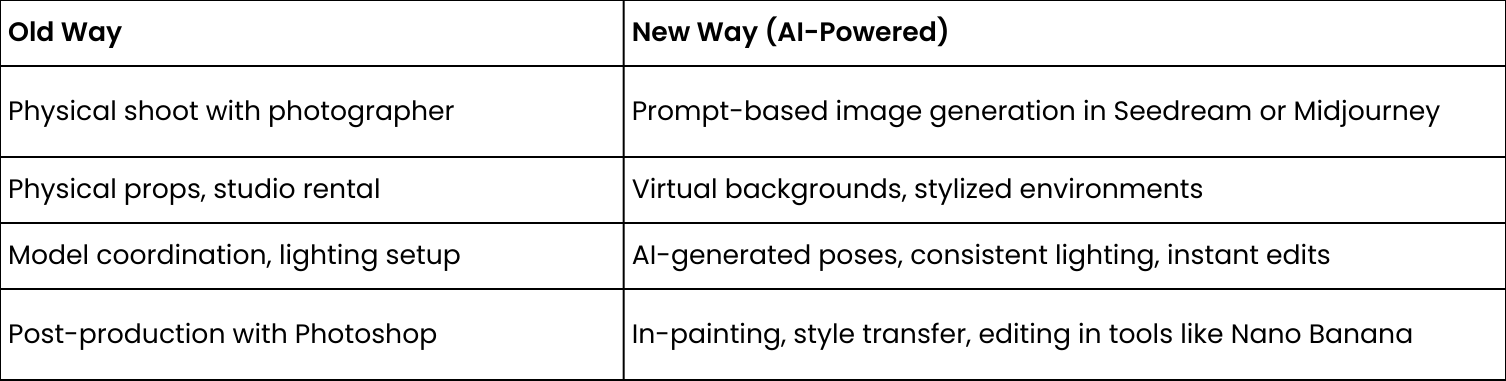
This transition enables speed, scale, and style diversity that manual methods can’t match.
2. Tools Powering the Shift
a. Seedream 4.0
- Best for high-quality, reference-based product visuals
- Great at handling consistency across campaigns
- Multi-image inputs allow brand look to persist
b. Nano Banana (Gemini 2.5 Flash Image)
- Edits real photos, making it ideal for rapid testing of product styles
- Allows iterative edits while preserving subject identity
- Can simulate lighting, style, and environment changes instantly
c. Midjourney v6+
- Best for highly stylized and concept-driven visuals
- Great for campaign moodboards, launch teasers, and social content
- Less predictable with brand consistency unless well-prompted
3. Use Cases: Real Applications by Brands
a. Rapid Variant Generation
A skincare brand can create 10 versions of a product photo:
- One in a beach setting
- One in a marble bathroom
- One surrounded by flowers
- One in holiday-themed colors
No reshoots. Just a new prompt.
b. Localized Visuals
Global brands can tailor the same product for different markets:
- In Japan: cherry blossom background
- In Sweden: minimalist kitchen
- In Brazil: vibrant, tropical setting
c. Seasonal or Trend-Based Assets
React fast to pop culture or seasonal cues:
- Halloween version of your packaging
- Valentine’s Day mockups
- AI-created UGC-style visuals for TikTok trends
d. Product Launch Mockups
Before production even finishes:
- Generate product-on-shelf visuals
- Simulate retail packaging
- Visualize product bundles or new line extensions
4. Benefits for Brands
Speed
- Cut time from concept to asset from weeks to hours
- React to cultural moments or campaign needs instantly
Cost Efficiency
- Reduce studio, freelance, and logistics spend
- Enable small teams to create high-volume assets
Scalability
- Test 50+ visual versions of a campaign
- Personalize product visuals by persona or region
Creative Control
- Experiment with bold styles without production risk
- Explore multiple campaign directions in parallel
Consistency
- Use reference images and prompts to preserve brand visual language
5. Challenges & Ethical Considerations
a. Authenticity & Trust
- Consumers value realism. Over-stylized AI content can seem inauthentic.
- Brands must balance imagination with credibility.
b. IP & Legal
- Who owns AI-generated visuals?
- Are models allowed to simulate real people or brand environments?
- Disclosure rules are emerging (e.g., FTC guidance on synthetic content)
c. Bias & Diversity
- Many AI models underrepresent or distort certain demographics
- Prompting must be inclusive and diverse
d. Quality Control
- AI images can have subtle issues (distorted hands, inconsistent shadows)
- Human review is still essential for brand-critical assets
6. New Creative Workflows
Instead of replacing creative roles, AI is evolving them:

Workflow Example:
- Creative lead defines visual direction
- AI operator generates variants
- Designer edits and aligns with brand
- Marketer selects and deploys based on campaign needs
7. Building an AI-Ready Visual System
To adopt AI product photography at scale:
a. Brand Style Guides for Prompts
- Translate tone into promptable language ("warm light", "pastel palette")
- Include positive and negative prompt examples
b. Prompt Libraries
- Document effective prompts by campaign, product line, and channel
- Pair with reference images and outputs
c. Asset Management
- Organize AI assets in DAM tools by meta-tags
- Track usage rights and disclosures
d. QA Process
- Review all AI outputs before publishing
- Check for artifacts, brand misalignment, over-processing
8. The Future: What Comes Next

a. Real-Time Content Generation
- AI-generated product images on the fly for individual shoppers
- Use in recommendation engines, emails, dynamic landing pages
b. AI-Generated Video & 3D
- From stills to rotating 3D product views
- Short AI-generated product explainer videos
- VFX motion scenes using tools like Higgsfield
c. Retail Simulation
- See how packaging looks on shelf, in virtual stores, or AR experiences
d. Voice-Prompted Content Creation
- Describe a visual to your AI assistant and get it in seconds
e. Full AI Shoots
- Entire campaign visuals done in AI — concept, set, model, environment, lighting
9. Case Studies (Real or Modeled)
Case A: DTC Beauty Brand
- Problem: Inconsistent product visuals across Instagram, email, and site
- Solution: Used Seedream to generate cohesive image sets from reference photos
- Result: 38% increase in visual engagement, 4x creative volume with same team
Case B: Electronics Launch Campaign
- Problem: Too slow to react to seasonal trends
- Solution: Used Nano Banana to edit hero product shots with winter/summer themes
- Result: Time-to-launch for new visuals cut by 80%
Case C: Boutique Apparel Brand
- Problem: High photo shoot costs for low-SKU collections
- Solution: Midjourney and Higgsfield for social visuals + lookbooks
- Result: Reduced photo budget by 60%, launched 3x more campaign variations
10. Strategic Takeaways for Visual Branding
- AI is a visual multiplier. Use it to explore more, faster.
- You still need human taste. AI can create. It can’t decide.
- Prompt engineering is a brand skill. Your team must learn it.
- Plan for scalability. Build systems, not just single outputs.
- Balance imagination and authenticity. Visuals must resonate, not just dazzle.
Conclusion
Generative AI has transformed product photography from a constrained, expensive process into a flexible, scalable creative engine. For brands, it unlocks rapid ideation, visual experimentation, localization, and cost-effective scaling.
But this power must be managed thoughtfully. Authenticity, inclusivity, quality, and brand alignment still matter — perhaps more than ever. The best AI strategies are hybrid: pairing automation with human judgment.
In 2025, your brand is the sum of its visuals. And with AI, you now control that visual system with unprecedented speed and precision.
Whether you’re launching a product, testing a campaign, or building a new brand from scratch — AI isn’t just supporting your creative team.
It is your creative team.
Schedio helps brands build AI-first creative workflows that scale visual storytelling.