


Nano Banana vs Seedream vs Higgsfield: Which Generative Visual AI Tool Should Your Company Pick?

Helping companies choose the right visual AI platform means balancing image quality, speed, consistency, cost, and workflow fit. We compare three rising tools — Nano Banana, Seedream 4.0, and Higgsfield — so you can make an informed decision.
Introduction
Generative visual AI is evolving fast. What was experimental a year ago is now reshaping digital marketing, product design, social media, and branding. Tools like Nano Banana (from Google), Seedream 4.0 (from ByteDance), and Higgsfield are redefining how companies create content at scale.
But these tools are not interchangeable. They differ in functionality, speed, output quality, control, and cost. If you’re building a scalable creative workflow or looking to boost marketing output, this guide will help you decide: Which of these AI tools is best for your business?
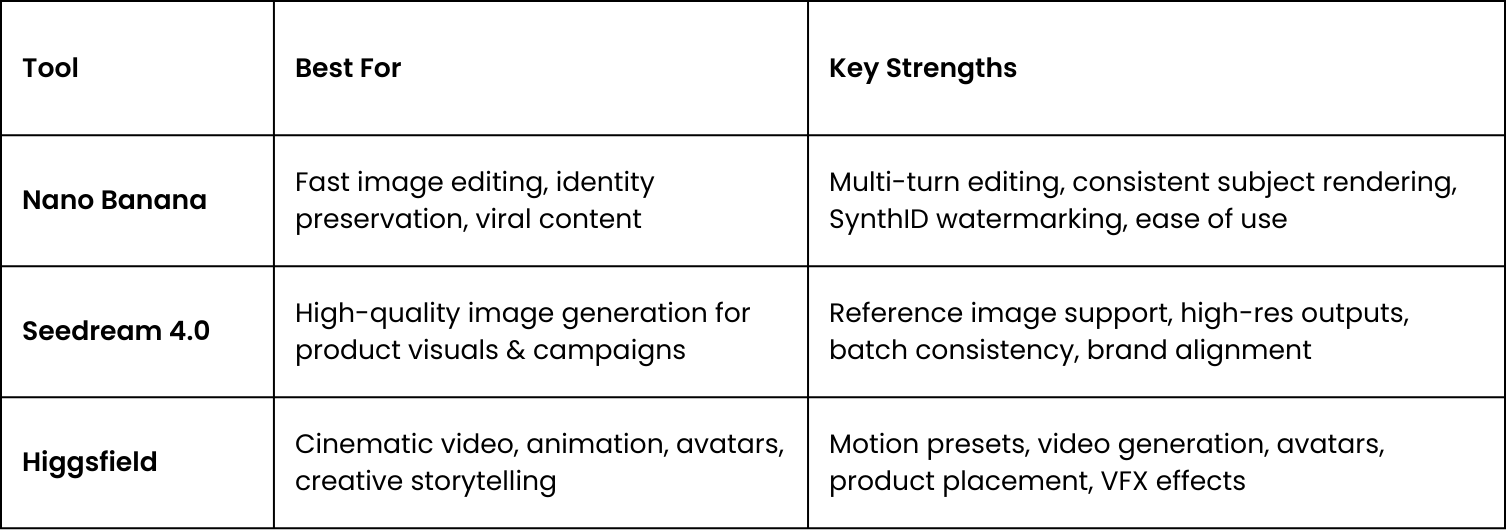
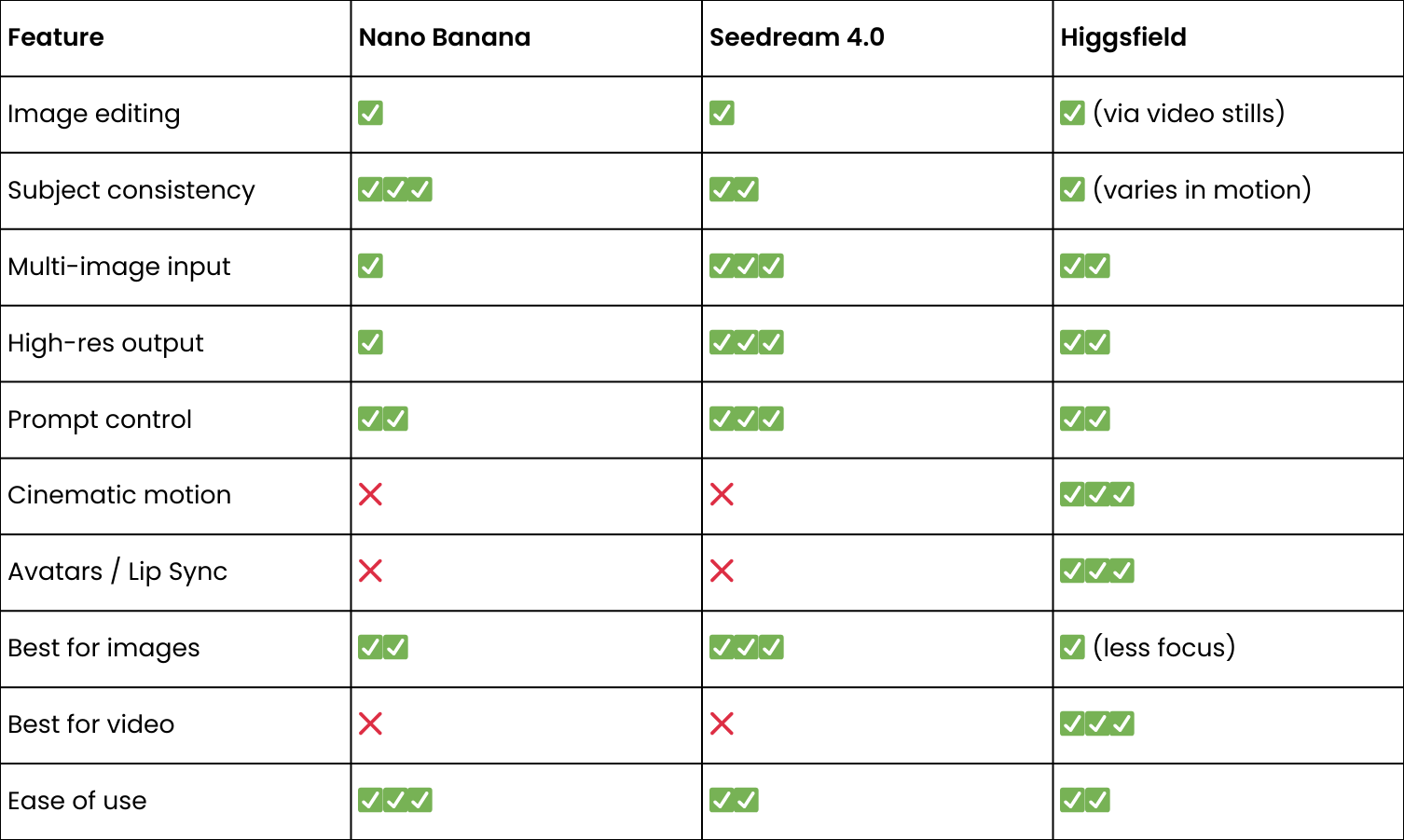
Tool Comparison Summary
In-Depth Breakdown
Nano Banana (Google Gemini Flash Image)
Use case: Quick photo edits, social media visuals, content personalization
Standout strength: Identity preservation — faces, pets, and objects stay consistent across edits.
Unique features:
- Multi-turn editing with context retention
- Image-to-figurine transformations
- Blend multiple photos or styles
- Lightweight, mobile-accessible via Google Gemini app
- SynthID watermarking for ethical use
Best for: Creative marketing teams, social media managers, startup founders who need fast, consistent edits from real photos.
Seedream 4.0 (ByteDance / Seed)
Use case: Campaign production, e-commerce asset generation, brand image control
Standout strength: Multi-image reference support + high-res generation at scale
Unique features:
- Reference-based generation (great for brand/product consistency)
- Fast turnaround (~2 seconds/image)
- Great prompt alignment, aesthetic quality
- More fine-tuned control over lighting, detail, realism
Best for: Design teams, product marketers, visual brand leads managing many assets that need consistent rendering or batch visuals.
Higgsfield
Use case: Short-form video, UGC-style content, motion-based storytelling
Standout strength: Converts static images into cinematic motion/video
Unique features:
- Camera motion presets (zoom, pan, dolly, etc.)
- Draw-to-video tools and scene composition
- Talking avatars + lip sync
- Seedance Pro for multi-shot storytelling
- VFX, outfit swaps, product placement
Best for: Creative studios, DTC brands, influencers, or any company producing short-form video, reels, or interactive ad content.
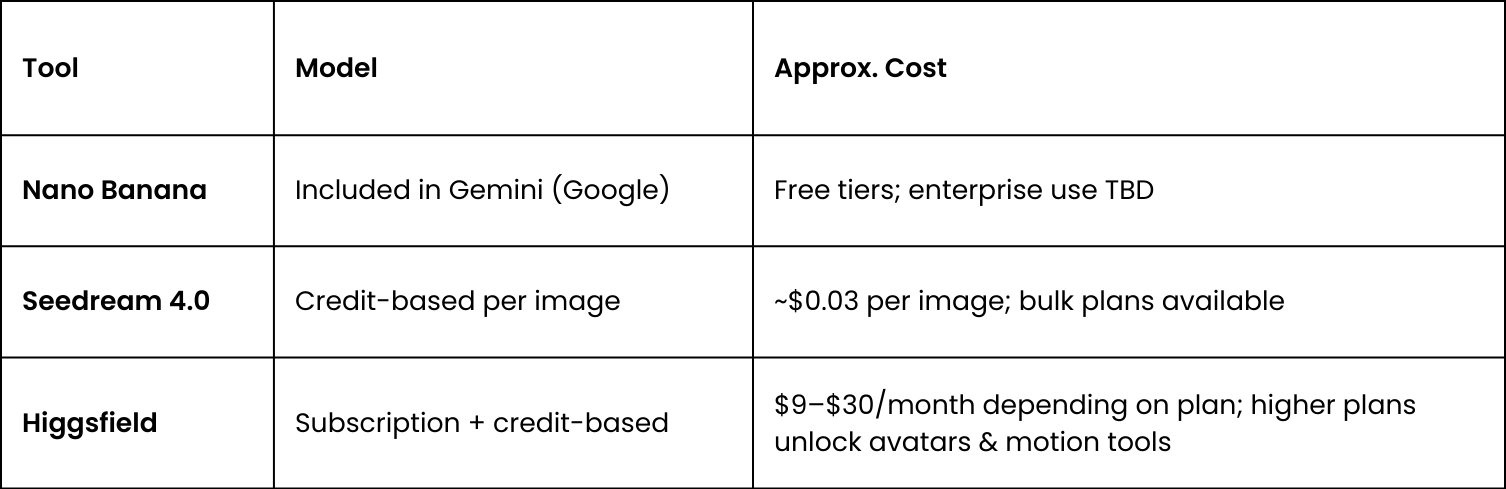
Pricing Snapshot (as of Q3 2025)
Real-World Use Cases

1. Social Content Creation
- Tool: Nano Banana or Higgsfield
- Why: Easy tools, rapid edits, strong identity preservation, fun styles for engagement
2. E-commerce Product Shoots
- Tool: Seedream 4.0
- Why: High-res, reference consistency, campaign-ready batch generation
3. Brand Launch Video / Ad Teasers
- Tool: Higgsfield
- Why: Cinematic transitions, product zooms, motion effects, storytelling elements
4. Prototyping Visual Concepts
- Tool: Combo (Nano for static, Higgsfield for motion)
- Why: Iterate quickly, test concepts before committing to full campaigns
Feature Comparison Table
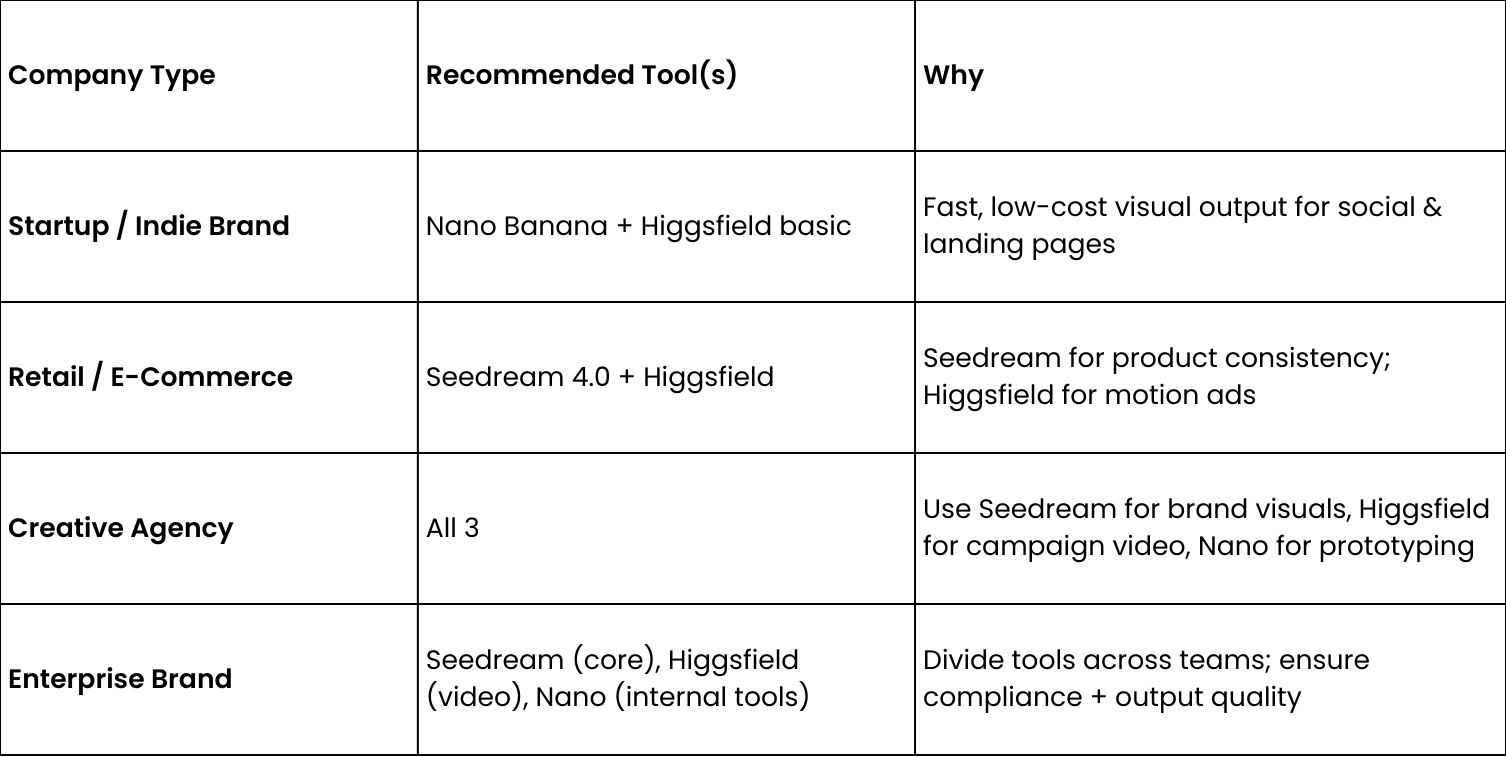
Strategic Decision-Making: Which Tool Should You Pick?
Key Takeaways
- Nano Banana is the easiest to use and great for casual, fast content. Think: social media, internal mockups, early-stage testing.
- Seedream 4.0 is the best image engine if you care about consistency, fidelity, and campaign-level outputs. Great for e-commerce, brand consistency.
- Higgsfield goes beyond images into cinematic video — essential for short-form content, paid ads, and social storytelling.
Most businesses won’t pick just one. Instead:
- Start with Nano Banana for social or inspiration
- Use Seedream for official product/campaign visuals
- Add Higgsfield for video production, motion ads, and multi-platform content
What to Watch in 2025
- Tool convergence: Expect tools like Seedream and Higgsfield to expand across formats (images + motion + 3D).
- Better APIs: Automation for high-volume content is on the rise. Watch for deeper integrations.
- Ethical tools: SynthID watermarking (from Google) is just the start. Expect more AI traceability.
- Creative teams upskilling: The best ROI isn’t from the tools, it’s from teams learning to use them well.
Final Thoughts

Choosing a visual AI platform in 2025 is less about “best tool overall” and more about matching the right tool to the right job.
Nano Banana wins for its simplicity and identity control. Seedream 4.0 wins for fidelity, quality, and scale. Higgsfield wins for storytelling, motion, and creative richness.
The best strategy? Combine them. Build a creative stack around your needs. And iterate quickly.
Your next campaign doesn’t need a full studio. Just smart choices and the right AI.